Showing posts with label Trust: Second Acts in Young Lives. Show all posts

Tuesday, March 05, 2013

Regions


Martin McCaffery’s tour of Montgomery raised my awareness about the history of the southeast region and after visiting Charleston, which is an utterly charming place to spend a couple of days, I read a little bit about the history of slavery there.  During slavery the city was an urban slave-trading center and the Civil War started at Fort Sumter in Charleston Harbor, and .  http://www.nps.gov/nr/travel/charleston/osm.html 

Scene from Downside UP
Last fall, when I noticed on the Southern Circuit schedule that TRUST would screen at the Halsey
Institute of Contemporary Art in Charleston,  I mentioned to our host Lizz Biswell that Kenji and I had made a documentary about how the Massachusetts Museum of Contemporary Art (MASS MoCA) brought my dying home town back to life.  Lizz arranged for me and Kenji to speak to Assistant Professor Jeanette Wood Guinn’s Art Management class.  Apparently, Jeanette has used Downside UP in her courses for years, and all her students have seen the film.  Jeanette asked us some probing, thought-provoking questions and we spent an enjoyable hour and a half with her and her class.  www.downsideupthemovie.org

Exhibit at the Halsey
The next day, Kenji and I were essentially free from any obligations, and we really enjoyed walking around the city, it was a great contrast with all the hours we spent on the plane and in the car.  Kenji and I stayed in an historic guest house on the College of Charleston campus, visited the Halsey's galleries, and walked around enjoying the beautiful buildings, the blooming rhododendron, azalea and magnolia, the pelicans diving into the harbor and the river flowing broad and fast.

Gwen Clancy and me, Surprise Valley, CA
When we were flying home to San Francisco, I raised the shade on the window and saw that we were flying over the Sierra Nevada mountain range.  The young, jagged ridges were covered in snow, the valleys were brown and bare, the area covered by the mountains was broad and long.  I fell in love with the western US in the 1970s, during a Sierra Club hike in the Idaho Primitive Area.  I was in my early 20s at the time, had just graduated from college, was working my first professional job as a health educator, paying off my one small college loan, figuring out life.  I loved those raw granite mountains, loved getting above tree line and seeing miles and miles of wild land, I loved the high elevations, the thin dry air, the way the stars and the sky sparkled through that aridity, I loved the independent self-sufficient attitude of the Western people I met, they seemed different in a basic way from the people I knew in working class Massachusetts where I grew up.  I loved the way their eyes seemed accustomed to looking out over vast distances.  I loved the way horses were a part of life there.

After those two weeks backpacking in the wilds of Idaho, I returned to Massachusetts and every morning, as I drove my car or rode my bicycle east from my house to my office, I said to myself, “I wish I was driving west.” 


Three years later, while editing our documentary A Cowhand's Song in San Francisco, I met my future husband, native Californian Kenji Yamamoto and get up into the Sierras as often as possible.

Although I had loved getting to know a bit about the southeastern region of the US and meeting so many wonderful people there as I traveled from city to city showing TRUST, I was very happy to get back to the region that spoke to me so many years ago and became my home.

Friday, March 01, 2013

Visiting the Boys and Girls Club - Tupelo, MS


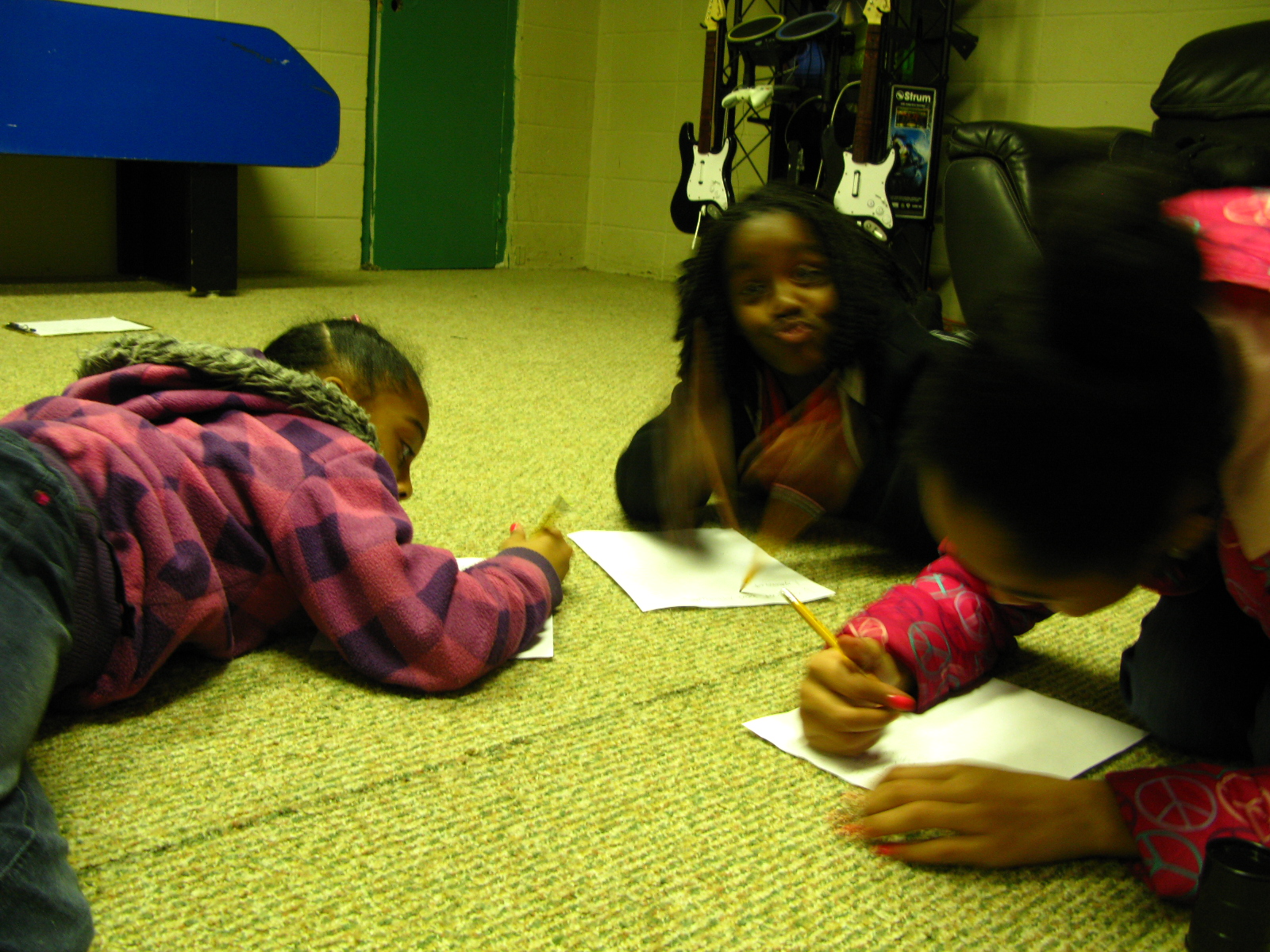
A train runs right through downtown Tupelo and it made me and Kenji (who joined me for the last couple of stops on the Southern Circuit) late for our session with the Tupelo Boys and Girls Club.  Pat Rasberry, our host in Tupelo, arranged for us to spend 45 minutes with them, not enough time to show all of TRUST, so we figured we’d show them the TRUST sequence in which David guides the ensemble members through writing recipes for how to make themselves, then talk with them about units of measure for recipes, actions you do in making a meal, give them time to write their receipes and then ask those who wanted to read their recipes to read them to the group. 


 After two years’ work, we are in the last stages of designing the TRUST Teaching Guide and Community Screening Kit – it goes to the printer later this month.  And we are starting to use it in after school and classroom situations - As you can see from these photographs, it was a lot of fun, the kids really got into writing recipes and were really courageous about standing up and reading them.  The group was also very curious about how to make a film, how to become a filmmaker, how they could be in one of our films.  One member of th club wanted to know how to become an actor, and the Boys and Girls Club teachers said they’d hook him up with a Tupelo theater company that has a summer program for teenagers.  That was a real highlight.
 Watch on www.recipesfortrust.com to see some of the recipes the members of the Boys and Girls Club wrote.


Pat Rasberry and Melanie Deas, Executive Director of the Link Centre where TRUST was to screen, took me and Kenji to dinner.  Over dinner, we learned that Melanie attended Yale Graduate School of Drama with APTP Artistic Director and Co-Founder David Feiner! 

And did you know that Tupelo is Elvis’ birth place?  After the screening, Shawn Brevard took us on a tour of Elvis hot spots in Tupelo – Tupelo Hardware where he bought his first guitar and to the shrine at his birth place.  It was just too funny.

The TRUST Cake


It’s a long darned drive from Montgomery, Alabama to Gallatin, Tennessee.  My mother and I had to smile at a sign we passed on Highway 65 – “Go To Church or the Devil Will Get You.”  Both Martin from the Capri Theater and Jim, our host at the Lattice Inn where we stayed in Montgomery, told us to keep our eyes out for it.  It was hard to miss.

I dropped my mother off at my sister and brother-in-law’s house in Huntsville, Alabama, and zoomed past Nashville to Gallatin, which has made a huge effort to revive its historic downtown, starting with fixing up and opening the Palace Theater.  My host, Donna Belote, Executive Director of Greater Gallatin, said that twenty some years ago when they started trying to bring the downtown back to life, someone said that the only way the downtown would come back to life was to knock it down and replace it with a Home Depot or a Walmart.  As someone who made Downside UP www.downsideupthemovie.org a documentary about the revitalization of my home town North Adams, Massachusetts I was happy to be part of an event in an up-and-coming downtown, with businesses and restaurants, and bars with live music.
Pharmacy repurposed to a bar in Gallatin

Sugar Paper!
This is the first year Gallatin has hosted Southern Circuit filmmakers and Donna has a nice group of people who get together to support the screenings – the mayor and a member of the city council attended and after the screening, they had a nice reception that included a special TRUST cake.

Photo: Amy Braswell, © Kelly+Yamamoto Productions 2010
I’ve noticed that in these Southern Circuit screenings, unlike any other TRUST screenings I’ve attended, members of the audience want to know how the Albany Park Theater Project (APTP) supports itself.  Chicago has a great tradition of the city and foundations supporting the arts and supporting theater and David Feiner, artistic director and co-founder, spends a lot of time fundraising, as do members of his board.  They get their fantastic space from the Chicago Parks Department.

At the end of the discussion with the audience, Paige, the MC, excitedly announced that Gallatin has been invited to take part in the 2013 – 2014 Southern Circuit.  I wish I had had more time to spend in Gallatin, the little taste of music I heard was terrific.

Intersections


Intersections
Martin McCaffery

If Martin McCaffery, Director of the Capri Theater in Montgomery, AL, ever offers to take you on a tour of Montgomery, say “Yes!”  I said yes on behalf of my mother Ginny and myself and was glad I did.  I used the Montgomery screening as an excuse for a family reunion, and met my mother, who lives in Venice, Florida, at the Atlanta Airport as I drove from Madison, GA to Montgomery.

As with the other stops on the tour so far, I have never been to Montgomery.  I knew the city was an epicenter in the Civil Rights movement, but I had no idea how close one place is to another: Martin Luther King Jr.’s church is just a block or two down the street from the Alabama State Capital where the march from Selma to Montgomery ended and is precisely across the street from the Alabama Supreme Court building.  The church is also within a few blocks of where slaves were sold before the Civil War, after being brought in from the river. 

As we were getting out of his car in downtown Montgomery, Martin asked whether we liked monuments.  I am not crazy about looking at monuments, but I just followed him up the marble State Capitol steps and across its manicured grounds to a monument to the Confederacy’s three flags, something I never would have stopped to examine without him. Martin is very sharp about pointing out the difference between what is being said and what is going on behind what is being said - and explained in his dry, humorous way that although the Confederacy lasted only four years, it had three flags.  The first, it was decided, resembled the Union flag too much.  The second had the St. Andrews Cross in its upper left hand corner and the rest of the flag was white.  It was decided that when this flag was unfurled, it looked too much like the flag of surrender.  So it was replaced by yet another flag.  Never having spent any of my adult life in this region, I was fascinated. 

Next we visited the three statues on the grounds of the state house: Jefferson Davis, a legislator, and the father of modern gynecology, who, Martin pointed out, was doing his work prior to the Civil War and must have experimented on female slaves to learn what he learned. 

And then, a very short walk from the state house, near the Southern Poverty Law Center, is Mya Lin’s Civil Rights Memorial. Carved into a vertical piece of black granite is a quote from Martin Luther King, Jr., “Until justice rolls down like water and righteousness like a mighty stream, and righteousness like a mighty stream.” In front of that is a unique fountain in which water flows over a flat oval shaped table like surface in which significant dates in the Civil Rights struggle are carved in a pattern radiating from the center. 

Hank Williams and his ex-wife are buried on top of a hill in a Montgomery cemetery.  People go to his grave to watch the sunrise. Did you know there is a typo in his ex-wife’s head stone? 

And then, as if there needed to be more juxtapositions of present and past ironies, Martin then took us to the intersection of Jefferson Davis Avenue and Rosa Parks Avenue. 

It was kind of a thrill to see TRUST on the Capri’s marquee that night.  My niece Ami DuBois, who is a Ph.D. candidate in physics at Auburn University and is preparing to defend her dissertation this fall, drove to Montgomery with her boyfriend Adam for the screening.  

Nancy with Cheryl Hardley from STAR
Cheryl Hardley from Standing Together Against Rape (STAR), the Montgomery counseling center, joined us for the screening and discussion with the audience.  The discussion after TRUST often ranges widely, from the transformative power of theater to prevention of child sexual abuse to filmmaking. But when someone from a local rape crisis center joins us, there are always questions about trauma and sexual violence, and it always feels like people in the audience learn something new. 

Some film school students in the audience were very complimentary of a structural device we used in TRUST – returning several times in the course of the film to APTP’s sacred story telling circle where Marlín tells her story to the company.  This was an idea Kenji had after he input the footage of Marlín telling her story when she spoke for an hour and forty five minutes.  Kenji’s idea was to structure the film so that Marlín told her story in parts and when each part ended, the audience would think the stakes couldn’t get any higher, and then, when we cut back to Marlín telling her story, the stakes in her story would get higher. 

Martin made our visit to Montgomery a lot of fun – and an education.