Sunday, September 25, 2011

Birmingham connects community partners with 'Concrete, Steel & Paint'

The lobby was buzzing with activity at the Alys Robinson Stephens Performing Arts Center in Birmingham, AL. A pre-screening reception invited guests to gather early, schmooze, and take some time to peruse the display tables assembled with an array of resources. This included The Restorative Justice Team of the North Alabama Conference of the United Methodist Church who were on hand with brochures about restorative justice and information about an effort they are spearheading to connect faith-based groups in north Alabama engaged in restorative justice and prison outreach ministries; Justice and Mercy (JAM), – a coalition providing education and action on the death penalty; Kairos a prison ministry network serving incarcerated men, women and children, their families and others working in prison settings; and Hands On Birmingham connecting people with volunteer opportunities to serve their community.
A steady flow of people streamed into the auditorium and as the seats filled, the crowd numbered close to 100! Among them, Foster Cook, Founder and Director of Treatment Alternatives for Safer Communities brought a group of close to 30 people, which included TASC staff and clients. TASC offers an intensive case management program for criminal offenders with substance abuse problems, providing increased access to rehabilitation services and community-based sentencing alternatives to help them treat their addiction and recidivism rate.The Dannon Project - an organization that provides re-entry services to formerly incarcerated individuals and their families, was also well-represented, as was Space One Eleven, a visual arts organization and partner of the Alabama Prison Arts and Education Project.
I was excited to see so many individuals in attendance who are addressing issues related to crime, incarceration and justice. The exchange afterwards was vibrant and the organizations were given a chance to speak about their services and initiatives before the close of the discussion. There were also several opportunities for networking among the various groups.


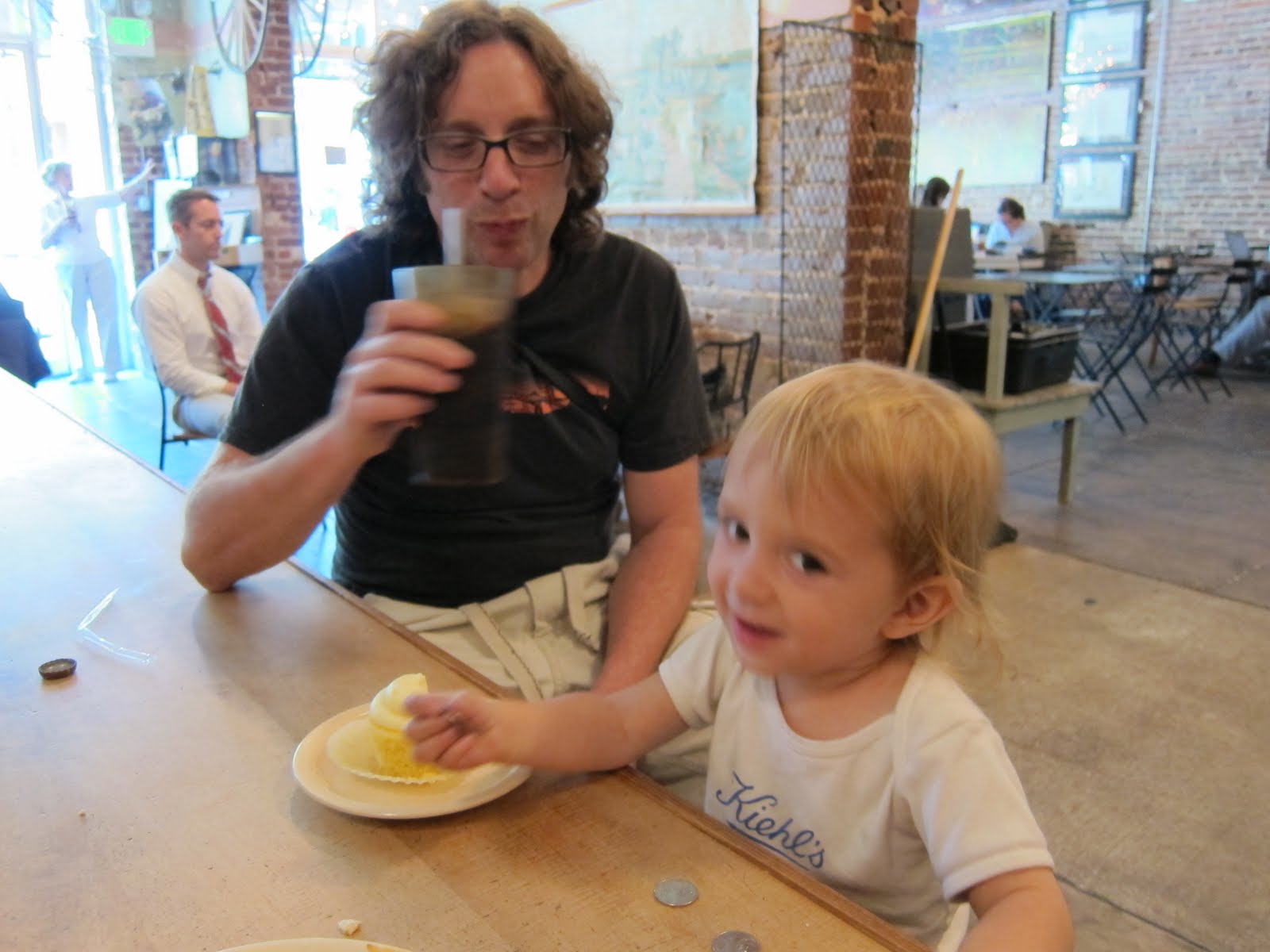
The next day was a day off. I caught up on some much needed sleep and then headed downtown to roam the art district, where everyone was busy preparing for the evening art walk. My son Jack had a good time chasing his shadow. I also discovered that he likes lemon cupcakes.

Thank you, Birmingham, for all of your hospitality and great effort for a wonderful event!


Saturday, September 17, 2011

"Surviving Hitler: A Love Story" opens Southern Circuit #1

I can't believe the Southern Circuit is over! Thank you South Arts. It was an amazing snapshot of the diverse South-- from the smoky mountains to the bayous, from the birthplace of Elvis to the birthplace of Davy Crockett. We screened in front of civil rights leaders, college freshmen, and stock brokers in theaters that ranged from works in progress to historic velvet-lined movie houses. And all in 10 days.

One thing remained the same throughout-- an overwhelmingly supportive and interested audience. We enjoyed huge turn outs at all of our screenings. Special thanks to the community coordination.  I hope our film affected you, the audience, in as positive way as the tour affected me. It was a thrill to be a part of it.


Thursday, September 15, 2011

Bridging "inside" with "outside" in Gadsden, AL

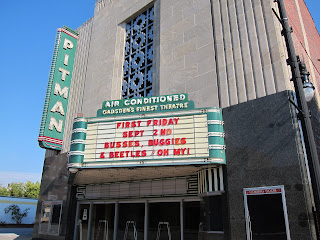
Concrete, Steel & Paint’ is a documentary that explores the value of connecting prisoners with the outside community. Mario Gallardo—Director of the Walnut Street Gallery and a Professor in the Art Department at Gadsden State College, took this message to heart and brought it to life by inviting inmates from the Etowah County Jail in the SCTIF public screening at the Pitman Theatre in downtown Gadsden. We had screened the film in prisons before, and even had the opportunity to coordinate bringing the public to those events, but never has this happened in the reverse.
Close to 20 inmates attended the Saturday night event escorted by Sheriff Entrekin, who was also joined by his wife.
Following the screening, it was a little awkward at first navigating between two sides of the room, but the physical boundary seemed to breakdown as the conversation continued. More and more people chimed in … on “both sides” as we did a round robin to hear first impressions of the film. Words like hope, courage, thought-provoking, real, and inspiring were among some of the descriptives.
One gentleman asked: “Why are there prisoners and crime victims?” His thought was more of question meant to ponder what it is about our society that creates prisoners and crime victims, from a sociological standpoint.
A student, interested in art therapy, was riveted by the film – it gave her inspiration about the healing power of art. She commented on the fine line between prisoners and crime victims, between us and them, when you think about what we are all capable of and what can happen to anybody.
One of the incarcerated men was impressed by the courage of the partners to work together and see the project through.
The Sheriff talked about his restorative program approach, the importance of restitution and their mural painting projects.
The exchange opened up a bit when Bobby Welch, Executive Director of the Mary G. Hardin Center for Cultural Arts, asked the guys from the prison about coming out to visit and see the artwork there. While the questions were typically being addressed to me, Bobby broke the ice with this question. The Sheriff responded with an open invitation. I wouldn’t be surprised to find out that Gadsden has started its own planning for a ‘Healing Walls’ spin-off.
My hope, moving forward, is that we might replicate the audience diversity created in Gadsden, and find more opportunities for bringing the community together with people who are incarcerated.
This was a great start and has set a new precedent for the film’s potential to engage the very principles that it upholds – finding opportunities to bridge “inside” with “outside” and exploring the potential for what can happen in the exchange. Thank you, Mario and to all of the Gadsden partners (Mary G Hardin Center for Cultural Arts, Gadsden State Community College, Wallace Hall Fine Arts Center, Downtown Gadsden Incorporated).
The Historic Pitman Theatre in downtown Gadsden
screens 'Concrete, Steel & Paint'

Lafayette, LA weighs in on crime and incarceration

It was a long drive from Auburn, AL to Lafayette, LA, but there was no better welcome than arriving to my unique accommodations at the lovely downtown Buchanan Lofts (wow! comfort, class and style, with plenty of room to spread out). With just about three hours until “showtime” I am in search of seafood gumbo (if I left Lousiana without having any, I would surely have felt deprived). Luckily, I didn’t have very far to go. My lovely landlady Leah pointed me in the direction of Don’s Seafood and Steakhouse – the perfect combination of old school, good food, and kid friendly! I’m not a food photographer, but wanted you to see a glimpse of my gumbo bowl (yum!), and another shot of my son, enjoying his French fries.


Stomachs full and ready for the night, I walk on over to the Acadiana Center for the Arts – a state of the facility in the middle of downtown Lafayette. I am in the building no more than 5 minutes and, lo and behold, an old college buddy from graduate school is there - Shawne Major! She saw the announcement on Facebook and showed up with her 11 year old daughter, Ruby, to say hello and see the film. What a nice surprise!

Following the screening, only a split second passed before the first hand went up. Gerd Wuestemann, the Center’s Director, told me that ACA audiences always have plenty of questions – this group was no exception. Most people seemed to be acquainted with one another. The exchange was comfortable and lively.

Award winning documentary filmmaker Pat Mire – Founder and Artistic Director of Cinema on the Bayou lauded ‘Concrete, Steel & Paint’ as a very important film that needs to be screened widely for public audiences. Public Defender Rebecca Hudsmith, who is also the Festival Director for Cinema on the Bayou, has a keen interest in restorative justice and extended a hand to support the film's educational outreach. A friend who attended with Pat and Rebecca approached me afterwards: “I’m a crime victim, she’s a public defender, he’s a filmmaker and my partner is a muralist – we were all represented!” The level of excitement and enthusiasm for the film was inspiring.
Pennsylvania (where I’m from) and Louisiana share two similarities regarding their incarceration statistics - they both are included in a list of only six states that have life sentences imposed without the possibility of parole, and are among the top five states with the highest number of people (more than 3,000) serving life without parole sentences.
Louisiana leads the nation in terms of the percent of its prison population serving life without parole, at 10.9 percent. In fact, it was in Louisiana that the practice first took off, and the expansion of life sentences started at the Louisiana State Penitentiary at Angola, the nation's largest maximum penitentiary, in the early 1970s, when most people sentenced to life terms were paroled after they had been deemed fit to re-enter society. Everyone in Louisiana has a 2% chance of being locked up.
The facts are troubling and the challenges are great, but change is not impossible and alternatives to punitive justice are increasingly becoming a part of the discussion. Learn more about how Louisiana is working with the VERA Institute of Justice and the Pew Center on the States to develop policy change intended to better manage prison growth, reduce expenditures in corrections and recidivism rates and increase public safety.
I felt I made some great connections in Louisiana with individuals who are interested in these issues and the film's potential to raise awareness about them. I hope we will stay in touch, and keep the conversation going!

Producer Steven Tabakin Flies South with A BIRD OF THE AIR

Who knew when we accepted the invitation to be a part of the Southern Circuit Tour of Independent film, that we'd be juggling schedules and scrambling to get ready to open the film commercially in New York City at the exact same time. A BIRD OF THE AIR, which is based upon the novel "The Loop" by Joe Coomer, a wonderful novelist out of Forth Worth, Texas, always felt like a perfect fit for audiences who might not have an art house cinema within driving distance, but for whom this work -- the film as well as the novel -- was always intended. It's an extraordinary story about ordinary people (and animals), and we've always felt that it's a universal story that can play anywhere. We were really thrilled and lucky that the film wound up in the hands of Mark Urman and Amanda Sherwin at Paladin. When it looked like the film was moving toward being released in late September we realized that the schedule would be a train wreck, but we decided the we had to forge ahead and we loved the idea of playing Gainesville, Manteo, Madison, Orangeburg, and Hapeville a few days before hitting New York City. We're right in the middle of an amazing tour and we've had to divide up the duties. Margaret Whitton, who directed the film and is my producing partner at Tashtego Films, was needed in in New York to do some media appearances and to present the film at a few screenings, so I packed my bag to represent A BIRD OF THE AIR in Gainesville and Manteo -- and now Raine Hall who worked on the film as a producer and a locations manager is on the road for the last leg.


In this space I'll share a few reflections on my experience presenting the film on the Southern Circuit Tour. For more info about the film you can go to http://www.abirdoftheair.com or find us on Facebook at http://www.facebook.com/abirdoftheair -- but first a few basic facts: A BIRD OF THE AIR marks Margaret Whitton’s directing debut. Filmgoers will remember Margaret as an actress who appeared in The Secret to My Succe$$, Major League, Nine and 1/2 Weeks, and many others. She also has a long last of credits onstage and we got to know each other when she was a directing a play that I was responsible for at The Public Theater where I worked for many years. Our film feature two breakout performances by two young stars on the rise -- Rachel Nichols (Conan the Barbarian, GI Joe: The Rise of the Cobra, Alias) and Jackson Hurst (Drop Dead Diva) -- who were introduced to us by casting directors Amanda Mackey and Cathy Sandrich Gelfond. Coomer's novel was adapted by Roger Towne (The Natural) and we filmed in and around Santa Fe, New Mexico with a team that included Academy Award-winning cinematographer Philippe Rousselot, costume designer Joseph G. Aulisi, production designer Mark Alan Duran. editor Sabine Hoffman, composer by David Majzlin. You might recognize some of those names, but if not you should look them up. It's an amazing team to have assembled for a small independent film. Ultimately, everyone who was involved in the process was drawn in by the story, from the most experienced veterans (and we had a few) to the student interns from on the first feature film. Okay, back to the Tour... In the middle of a busy week that included everything involved in getting a movie open, I packed my bag on got on a flight to Atlanta. The first screening was in Gainesville, Georgia at the Arts Council, presented in association with Gainesville State Colllege. I had spent some time in North East Georgia, and in fact my wife Jessamyn and I were married on Clarkesville, not too far from Gainesville 10 years ago, so I had been through town quickly -- but when I arrived, I was immediately impressed with the gorgeous building that had been converted from an old railroad depot. Several people were already gathering outside and it take didn't take long to spot Executive Director Gladys Wyant. With steam tables full of veggie lasagne, bowls of fresh salad, plates of cookies, and pitchers of iced tea, I already knew that this would be a different kind of experience. I sat down to eat with a bunch of students from Gainesville Tech and met Dr. Jeff Marker, a professor in the Media Studies department who has a very impressive background in film studies and English literature, who would conduct the interview following the screening. I also met Jeff Smith, also on the faculty at Gainesville State, who had a crew of students checking the audio and projection and setting up cameras for the post-show Q&A. It was a very welcoming environment and I had a good feeling about this audience. Precisely at 7pm, Gladys had everyone seated in the auditorium and made her introduction. Though I've obviously seen the film countless times, I decided that I'd screen the film with this audience. It's always interesting to get a sense of how the story is playing and it was very gratifying to hear the laughs, the gasps, the ooohs and aaahs at the right places. Clearly the film was very warmly received and soon as it was over I had a line of people coming up to shake hands and offer congratulations and ask questions. We had a quick break and I figured that we'd lose most of the crowd, but was pleased that by the time they had me wired for sound that almost everyone stuck around.

Wednesday, September 07, 2011

Auburn screening highlights arts in corrections in Alabama!

Hello Auburn! My first stop with Concrete, Steel & Paint on the Southern Circuit. The film's theme of arts in corrections was certainly a prominent feature in the post-screening discussion. Arts in Corrections is alive and well in the state of Alabama due to the tireless dedication of individuals like Kyes Stevens, Director of the Alabama Prison Art and Education Project (APAEP) and Jeannie Thompson, Director of the Alabama Writers Forum (AWF). I had been in touch with both of them prior to arriving in Auburn. I was fortunate that they were both available to attend my first screening of the tour, held at the Jule Collins Museum of Fine Arts. APAEP is headquarted at Auburn University - in the Department of Psychology, College of Liberal Arts. It is a remarkable program dedicated to bringing educational programs in the arts and humanities to prisoners in Alabama. It's an important resource for the Alabama Department of Corrections (DOC) and a favorite of Dr. Eddie Lancaster, Reentry Coordinator for the Alabama DOC who I had the opportunity during my stay. He is trained as a forensic psychologist, and lauds the importance of visual tools in prison settings as a pathway to higher learning and therapeutic self-expression. Pictured below, he proudly displays APAEP's traveling exhibit in the corridors of the DOC's downtown Montgomery office.
The Alabama Writers Forum serves the literary arts community in Alabama and through their work have developed a special partnership with Alabama's juvenile justice community. They manage "Writing Our Stories: An Anti-Violence Creative Writing Program" on three Department of Youth Services campuses. The Forum also collaborates with APAEP and other organizations to also serve adult prison populations. Having both Kyes and Jeannie present for ‘Concrete, Steel & Paint’ was an asset. “This is the best film I have seen about the struggle and strife between prisoners and crime victims, and that is very hard to capture," says Stevens. Thompson follows up by adding how well the film illustrates the power of art as a tool for dialogue. Their knowledge about arts in corrections programs contributed to the discussion. They also provided the audience with more information about their organizations and opportunities to connect with their work for anyone interested to get more involved. Thank you, Auburn, to the Jule Collins Smith Museum of Fine Art and to all of the film's friends and supporters who helped spread the word to everyone who joined us. It was a wonderful evening.
Pictured above (from left to right):
Kyes Stevens, Director-Alabama Prison Arts and Education Project;
Scott Bishop-Director, Jule Collins Museum of Fine Art; Cindy Burstein-Director/Producer, Concrete, Steel & Paint; Sheriff Jay Jones-Lee County;
Jeannie Thompson-Director, Alabama Writers' Forum